

How Long Does It Actually Take to Create a Work Order?

The form takes two minutes. Everything around the form takes twenty to sixty, spread across two or three people — and almost nobody measures it.
What actually happens
Ask a maintenance manager how long it takes to create a work order and you will usually hear "a couple of minutes." Ask a technician standing in front of a leaking pump at 6:40am and you will get a different answer. Both are right.
Here is the real sequence when a technician spots a problem on the floor.
They cannot act where they are. The tablet is in the shop, the mobile app times out on plant Wi-Fi, or the terminal is two buildings away. The issue gets written on scrap paper or held in memory until the end of shift.
They have to find the asset. Not the pump — the record. Is it P-204 or PMP-0204? Filed under the line or the building? If the asset was replaced last year there may be two records and no sign which one is live.
They describe the problem twice. Once in the description field, again to whoever asks later, because the field only captured "oil leak."
They guess at fields they cannot answer. Criticality, estimated hours, trade required, parts needed. A technician who knows the asset can answer some of it. One covering an unfamiliar area picks something plausible and moves on.
Then it waits. The work order sits unassigned until a planner reviews it, checks whether parts are in stock, whether a permit is needed, and who is qualified and available. Each is a separate lookup in a separate place.
Then somebody chases history. Has this happened before? What fixed it last time? The answer exists, buried in closed work orders nobody has time to search.
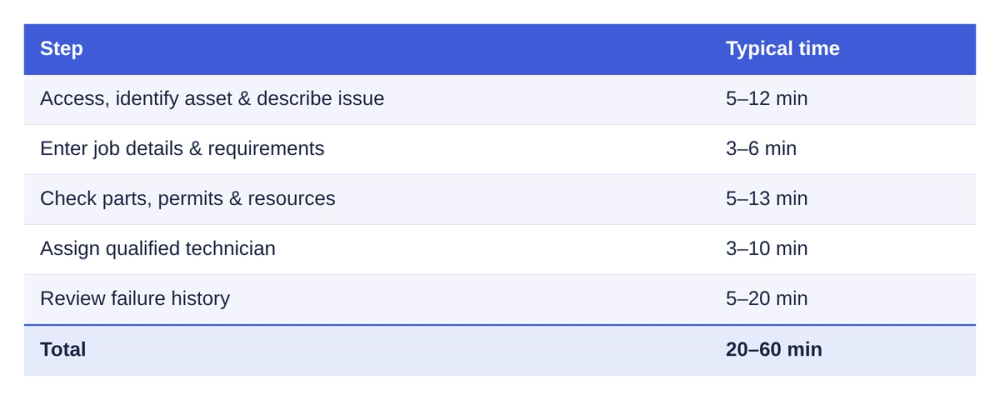
These ranges come from walking the process, not from a published study. Time your own and the shape will look familiar even if the numbers differ. That is the cost of one work order — multiply by how many your team raises in a week.
This is not a form problem
The temptation is to blame the CMMS interface and go shopping for a cleaner one. A faster form fixes almost none of the steps above, because almost none of them are typing.
The industry has a name for what this costs: wrench time — the share of a technician's paid hours actually spent with tools on equipment. The benchmarks are uncomfortable.
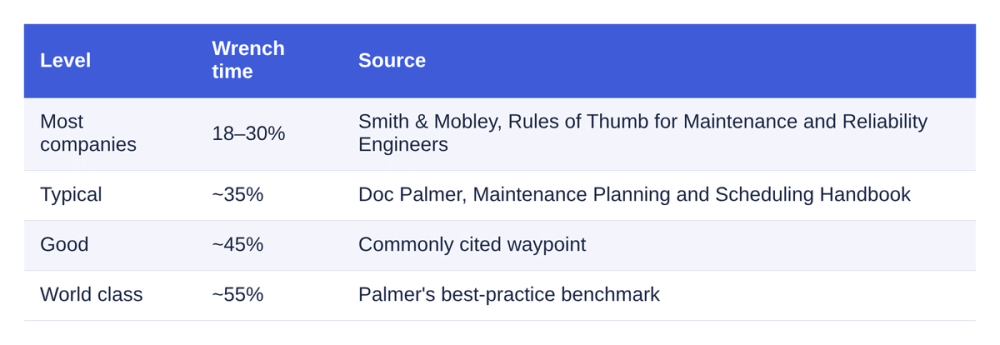
SMRP tracks it formally as Metric 5.6.1.
Read it the other way round. At a typical 35%, roughly two-thirds of a maintenance team's paid time goes to something other than fixing equipment — travel, waiting on parts, hunting for tools, and administration. The work order process sits squarely inside that two-thirds.
You cannot hire your way out of it. Adding a technician adds one more person at 35%.
What the same report looks like with AI agents
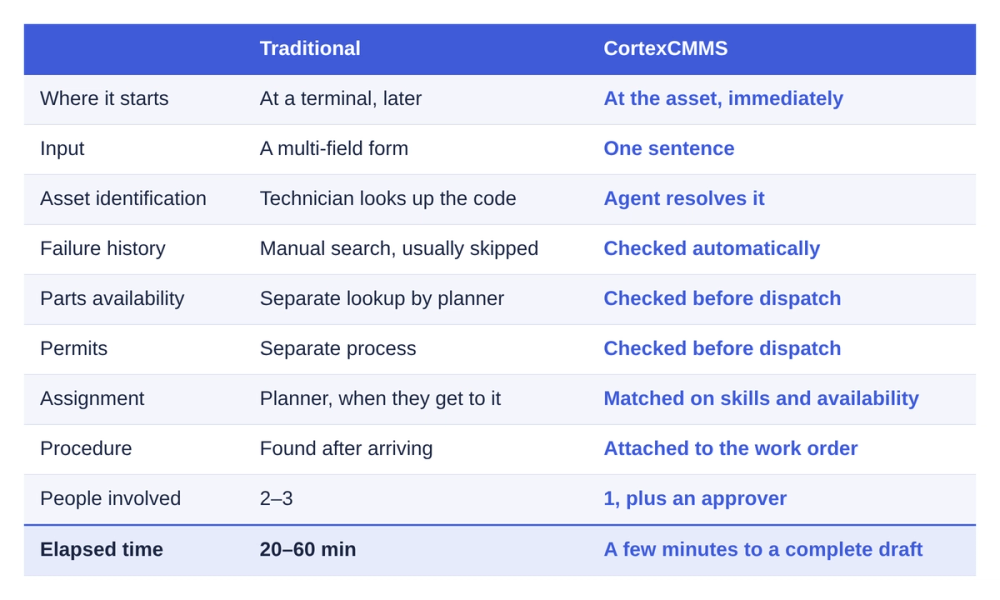
CortexCMMS starts somewhere else: the technician describes the problem in plain language, exactly as they would say it out loud, and seven specialized AI agents assemble the work order.
"Oil spill under the pump on line 4, looks like the seal again."
From that one sentence:
The request is captured from speech or text, on the spot, with no form and no asset code. The technician names the asset the way they call it, not the way it is filed.
The issue is diagnosed against that asset's history, past work orders and documentation. If the seal failed twice in the past eight months, that surfaces now, not in a retrospective nobody runs.
Parts, permits and people are checked before anyone is dispatched. Is the seal kit in stock? Is a permit required? Who is qualified and on shift?
The work order is created and assigned to the right person at the right priority.
The procedure is surfaced — the O&M manual, the guide, the step-by-step for that fix — so the technician is not searching for it after arriving.
Parts shortages are flagged and the team alerted to reorder, rather than discovered at the asset.
It reports back with MTTR trends, asset health and completion summaries.
No sensors. No IoT rollout. It runs on the maintenance history you already have. See the full list in Features and Capabilities, or how it connects to your existing systems through the CortexCMMS MCP Server.
Side by side
The part people worry about
Nothing dispatches itself.
Every decision a CortexCMMS agent makes carries cost, risk or safety with it, so your team reviews and approves before anything happens. AI agents do the assembling — searching, verifying, drafting, coordinating, and following up for approvals. People do the deciding.
It is offline-first, so it keeps working when the plant Wi-Fi does not. Every action is logged, and access is role-based.
Run your own numbers
Do not take ours. Take fifteen minutes and time this on your own floor.
1. How long from a technician spotting a problem to a work order existing?
2. How long from that work order existing to it being assigned and ready to execute?
3. How often does anyone check failure history before dispatch?
Multiply step 1 plus step 2 by your weekly work order volume. That figure is what the process costs you before a single wrench is turned. Then ask what your wrench time would look like if most of it came back.
Book a 20-minute demo — we will use your asset types, not a canned example.
References
Wrench Time Benchmarks: Typical, Good and World-Class Rates, Reliability Magazine
Doc Palmer, Maintenance Planning and Scheduling Handbook, McGraw-Hill
Ricky Smith & R. Keith Mobley, Rules of Thumb for Maintenance and Reliability Engineers, Butterworth-Heinemann, 2007
SMRP, Best Practices, Metrics, and Guidelines, Metric 5.6.1