

CortexCMMS MCP Server for CMMS: Connect Industrial Systems to Agentic AI
Architecture Overview
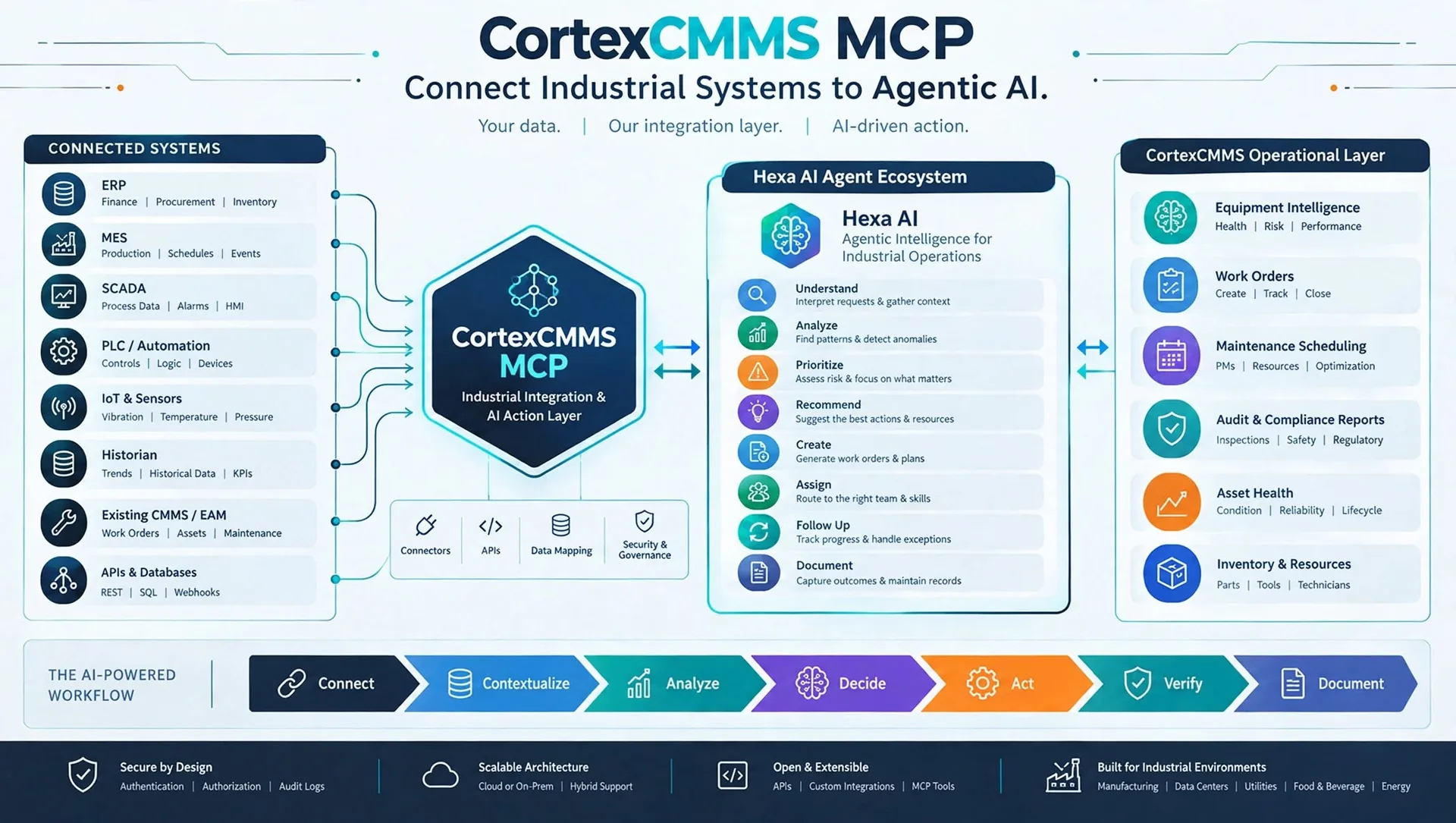
CortexCMMS MCP is designed as an integration and action layer that connects industrial and enterprise systems with the Hexa AI Agent Ecosystem. The architecture provides a structured pathway for bringing operational context into AI-driven workflows and, where configured and authorized, turning AI decisions into operational actions inside CortexCMMS.
The architecture separates four major layers: connected systems, the CortexCMMS MCP integration layer, Hexa AI agents, and the CortexCMMS operational layer.
Connected Systems
CortexCMMS MCP can be positioned between CortexCMMS/Hexa AI and the systems where operational data and enterprise context reside. Typical integration targets include:
The objective is to reduce the need for technicians, planners, engineers, and operations leaders to manually move information between disconnected applications.
CortexCMMS MCP Integration Layer
The MCP layer provides the integration boundary between external systems and CortexCMMS's agentic workflows. In an implementation, this layer can handle connectors, APIs, data mapping, authorization, security controls, and governance.
Hexa AI Agent Ecosystem
Hexa AI is the agentic layer within CortexCMMS. Instead of treating maintenance software only as a system for entering and retrieving records, the agent layer is designed to reason over connected context and coordinate multi-step workflows.
An equipment notification can be contextualized with asset history and sensor data, analyzed for maintenance relevance, prioritized, converted into a recommended action, and then routed through the configured work-order and approval workflow.
CortexCMMS Operational Layer
The operational layer is where maintenance and asset-management outcomes are represented and managed. Potential capabilities include:
Agentic Maintenance Workflow
Example MCP Resources and Tools
Security & Governance
Developer Integration Model
The developer-facing concept is to expose the systems and capabilities required by an AI application through standardized MCP primitives. The current MCP ecosystem defines servers that can expose tools, resources, and prompts to connected AI applications. This makes MCP useful as a protocol boundary between AI applications and the systems where enterprise or operational data and tools live.
For CortexCMMS, the architectural goal is to use this boundary to make industrial context accessible to Hexa AI while keeping system access governed by the enterprise's integration, identity, security, and authorization model.
Developer Integration Model
See how CortexCMMS MCP connects your systems to Hexa AI.